
RUNNING A LEARNERSHIP PROGRAMME: THE UNSEEN LOGISTICS THAT DETERMINE SUCCESS
Successful learnership programmes require more than training delivery. Behind every learner are complex operational processes, including recruitment, onboarding, compliance management, scheduling, stakeholder coordination, and learner support. These often determine whether a programme achieves meaningful outcomes.
When people talk about learnership programmes, the focus is usually on the outcomes.
Skills development
Youth employment
Workplace readiness
While those things are important, there is often far less conversation around what it actually takes operationally to run a successful learnership programme behind the scenes. The reality is that learnerships involve far more than simply placing candidates into a programme and hoping for the best. There are multiple moving parts constantly happening in the background, from recruitment, onboarding, and documentation to payroll coordination, training schedules, attendance tracking, transport and accommodation arrangements, site readiness, stakeholder communication, mentorship support, and ongoing reporting.
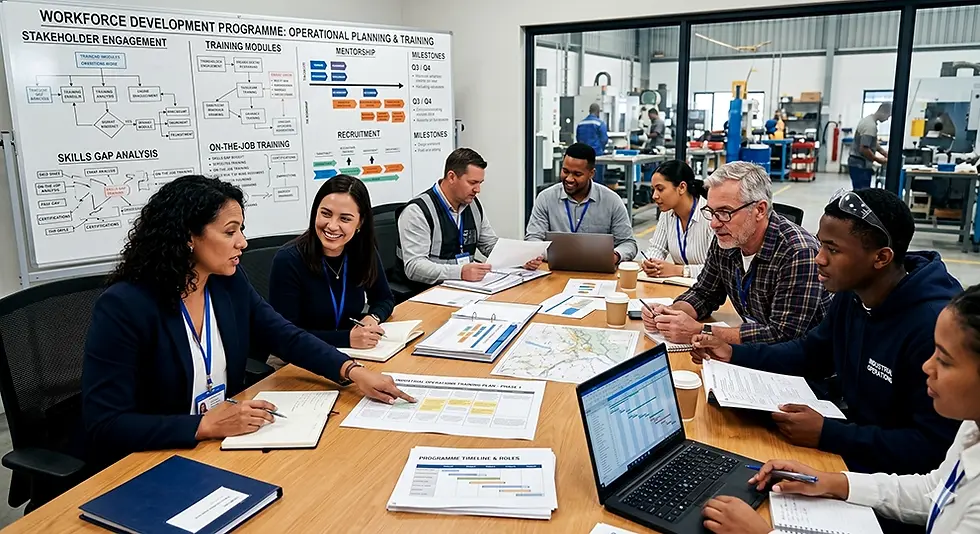
When programmes run across different regions or remote operational sites, those logistics become even more complex. Even one delayed document, transport issue, or communication breakdown can have a ripple effect.
That’s why operational planning matters so much.
Most people only see the training side, but a successful learnership programme usually depends on months of coordination before learners even arrive on site. It also requires understanding that every learner enters the programme with different personal circumstances, challenges, and expectations. For many young people, a learnership is not just another training initiative. It is a first opportunity into the industry, a first exposure to workplace culture, and often a major turning point for themselves and their families.
That human element is important. Behind every attendance register or compliance report is a person trying to build a future. And that is why communication, structure, and support systems matter just as much as the technical training itself. Training providers, operational teams, clients, mentors, and administrative support functions all play a role in determining whether a programme succeeds or struggles. When those parts work together effectively, learnerships become far more impactful and sustainable.
At the end of the day, successful learnership programmes are not driven by administration alone. They are driven by the people coordinating the unseen details every day to create opportunities that genuinely make a difference.
QUESTIONS ORGANISATIONS SHOULD CONSIDER
Are adequate support structures in place for learners?
How effectively are programme stakeholders coordinated?
What operational risks could affect programme success?
Are learners receiving both technical and workplace readiness support?
The most successful learnership programmes combine technical training with strong operational planning, effective communication, and ongoing learner support to create sustainable workforce development outcomes.
By Mapalo Chinyama, Operations Manager


Comments